
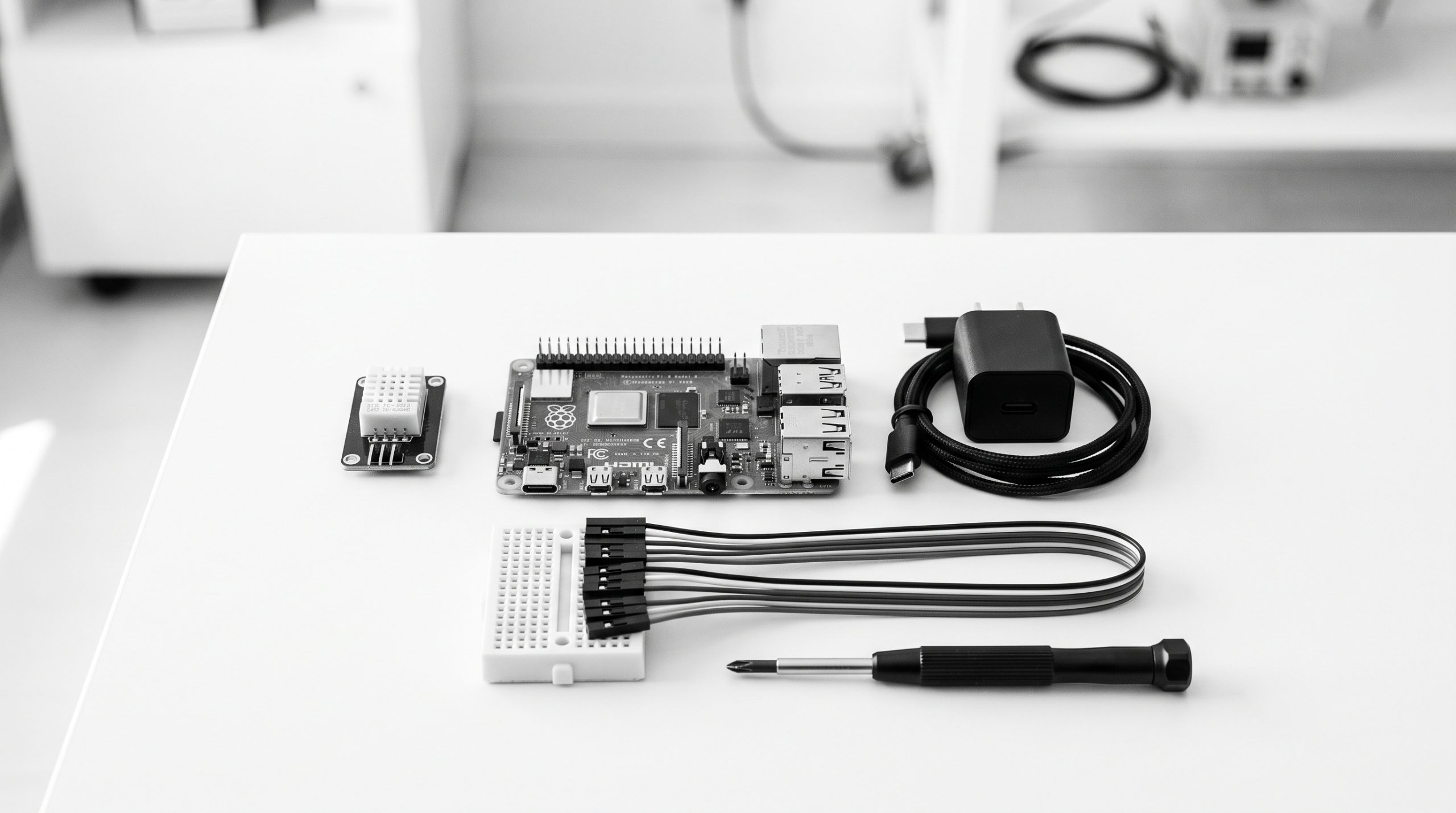
Start with the project you want to complete, then buy only the hardware that removes its next obstacle. For the first connected weather project, that means a Raspberry Pi, a DHT22 sensor, compatible wires, power, storage, and a network connection.
The minimum viable kit
| Item | Required? | Why |
|---|---|---|
| Raspberry Pi with GPIO | Yes | Runs the collector and connects to the sensor |
| Power supply | Yes | Provides stable power for the Pi |
| Storage with Raspberry Pi OS | Yes | Boots the operating system and project |
| DHT22/AM2302 module | Yes for this build | Supplies temperature and humidity data |
| Female-to-female jumper wires | Yes for this module | Connect power, data and ground |
| Breadboard | No | Useful for later circuits, not required for the breakout wiring |
Catalogue matches for the weather build
- CanaKit Raspberry Pi 5 Starter Kit PRO — combines board, storage, power, case and cooling for someone starting without Pi hardware.
- HiLetgo DHT22/AM2302 module — the sensor type used by the weather dashboard project.
- ELEGOO Dupont jumper wire kit — includes female-to-female leads for the module connection.
These are compatibility-oriented catalogue recommendations, not claims that the linked listings are the only suitable choices. Prices, availability, package contents and shipping can change. Check each listing before ordering. Meow Meow Scratch may earn a qualifying affiliate commission at no extra cost to you.
Raspberry Pi selection
You do not need a Pi 5 for a DHT22 collector. Reuse any compatible Pi with accessible GPIO, reliable power, supported Raspberry Pi OS, and enough storage. A newer board may make setup easier, but it is an upgrade choice rather than a project requirement.
Power and storage
- Use the power supply intended for your exact Pi model.
- Do not treat random phone chargers as equivalent; undervoltage can cause instability.
- Use a reputable microSD card or other supported storage and keep a recoverable backup of configuration.
- Keep the Pi ventilated; the sensor should be away from heat produced by the board.
Sensor and wiring checks
Read the labels printed on the module before connecting power. DHT22 breakout pin order is not universal. Use 3.3V GPIO logic, never connect a GPIO pin to a voltage outside the Pi’s specification, and do not expose this indoor sensor directly to rain or condensation.
What not to buy yet
- A large component assortment before your first reading works.
- A second Pi for a project that needs only one collector.
- Weatherproof enclosures for an indoor proof of concept.
- Premium sensors before you know which measurement and accuracy you need.
Next step
Use the selected hardware in How to Send Raspberry Pi Sensor Data to a REST API, then complete the end-to-end weather dashboard build.